Redux: A Tutorial on How To Build a Coke Can Stove for Hiking, Bushcraft and Camping

I was just looking over my Coke can camping stove tutorial and thought it might be a good time to post it again - it is such an easy stove to make, and lots of fun.

Okay, following up on a post about emergency preparedness, picture this: your power has just gone out. It is the middle of winter, and the battery-powered radio reports that a major substation has suffered an outage due to iced-over power cables. You are told to expect that power will return in no less than 7 days. So you get out all the blankets in the house, and warm up the bed. You find your 72 hour kit, first aid kit, candles, flashlights, your food supplies (some freeze-dried entrees and cans of food), water, radio and more. After all that fussing around, you decide you want a nice cup of coffee and a hot meal. You have a camping stove that runs on naptha but you'd rather use that outside so the fuel doesn't smell so strongly. You need a quick stove for in the house. A good option for this is an alcohol stove.

I was at a dollar store the other day wandering around the aisles. Other than the things we were actually going there to get, I started browsing the shelves with an eye on camping and bushcrafty things - products I could use directly or indirectly to fuel the fire of my hobby.

I saw a pile of Fondu Fuel bottles containing denatured alcohol and had a little ponder. After a minute of semi-deep thought, I decided that finally it was time I made a Coke Can Stove. Or a Pepsi Can Stove. Or a Pop Can Stove. Whatever you'd like to call it. But because I drink Coke, it would have to be a Coke Can Stove.

Boiling water is obviously important when camping or hiking or during a power outage. With one you can make hot drinks, heat meals (boil in a bag, or heat straight from the can), cook rice or eggs, wash for regular hygiene or for first-aid reasons, sterilize gauze or needles or sutures, and much more.

Now this is a very simple little stove. All that is needed to build one is a pair of Coke Cans (specifically the bottom half of each can), a tuna can or some kind of base, something to cut the drink cans (knife or scissors) and something to poke holes in the drink cans (pin, or drill, or awl, or a nail). Into the stove you pour the denatured alcohol, light it and heat up your food or boil water for tea.

Anyway, all I know is that it took me about 15 minutes to assemble a Coke Can Stove. Here is how you can do it too:

Acquire two cans of Coke and drink them quickly and grab a can of Tuna - consume tuna quickly. Rinse out the cans.

bushcraft, camping, hiking, stove, coke, algonquin, mungo, says, bah
First of all drill roughly 8 to 14 1/16th holes into the rim of one can - you can also use the awl on a pocket knife or a pin mounted in an Exacto-Blade sheath. These holes are the gas jets. Also drill 3 1/16th holes into the center of the concave section. These will serve as gas jets also, but primarily as the fuel-filling holes.

bushcraft, camping, hiking, stove, coke, algonquin, mungo, says, bah
Carefully score each Coke can an inch from the bottom using the tip of your knife resting on a solid item about 1 1/2 inches high (I'm using the tuna can above). Rotate the can against it a few times. This will keep the score consistent and level.

bushcraft, camping, hiking, stove, coke, algonquin, mungo, says, bah
Then remove the tops of each can by roughly cutting an inch above the score.


bushcraft, camping, hiking, stove, coke, algonquin, mungo, says, bah
Dispose of the cut off tops (recycle them).

bushcraft, camping, hiking, stove, coke, algonquin, mungo, says, bah
Slowly working your way around, cut tabs down to just above the score marks on each can using scissors.

bushcraft, camping, hiking, stove, coke, algonquin, mungo, says, bah
Bend them back and forth to get a neat break at the score line. This makes a very clean and straight edge.

bushcraft, camping, hiking, stove, coke, algonquin, mungo, says, bah
Dispose of the tabs (recycle them).

bushcraft, camping, hiking, stove, coke, algonquin, mungo, says, bah
The next step is to nest the two halves together, top into the bottom.

bushcraft, camping, hiking, stove, coke, algonquin, mungo, says, bah
You may find that bending little indentations in the top piece will help you slip it into the bottom piece.

bushcraft, camping, hiking, stove, coke, algonquin, mungo, says, bah
Be patient, it seems tricky, but you'll get it.

bushcraft, camping, hiking, stove, coke, algonquin, mungo, says, bah
Once it starts nesting, firmly and carefully tap the top section into place using a heavy object like a full can or a book.

bushcraft, camping, hiking, stove, coke, algonquin, mungo, says, bah
In the image above, you can see the fuel jets and the filling holes.

bushcraft, camping, hiking, stove, coke, algonquin, mungo, says, bah
This is a lightweight stove, which is also pretty tough. You can carry one around in your jacket pocket. The fuel is stored separately.

bushcraft, camping, hiking, stove, coke, algonquin, mungo, says, bah
I'm using a metal tray for safety above. The Bic lighter will get the stove going.

bushcraft, camping, hiking, stove, coke, algonquin, mungo, says, bah
Fill the concave cavity about 3 times with fuel and allow it to drain into the stove.

Then pour about a teaspoon of fluid onto the priming section (in this case the tuna can). The fuel within the stove needs to be primed before it can ignite - i.e. it is heated by the external flame on the priming surface until alcohol fumes are pressurized and are emitted from the fuel jets.

bushcraft, camping, hiking, stove, coke, algonquin, mungo, says, bah
Above you can see the priming flames begin to heat the stove and the fuel within.

bushcraft, camping, hiking, stove, coke, algonquin, mungo, says, bah
Here too - but I have used a regular empty tin can as the priming surface (better for the photograph). Soon the priming flames will exhaust themselves and burn out, hopefully not before doing their job.

bushcraft, camping, hiking, stove, coke, algonquin, mungo, says, bah
See the priming flames on the side of the stove in the image above, and the pressurized fuel jets beginning to ignite.

bushcraft, camping, hiking, stove, coke, algonquin, mungo, says, bah
Here the initial burst of pressure has subsided, replaced with the regular fuel jets burning. They will increase in size in a minute or so, once the stove has warmed up.

bushcraft, camping, hiking, stove, coke, algonquin, mungo, says, bah
In the image above, I have placed the stove within an Ikea cutlery drainer which I have used as a wood stove. Above it I have placed a camping pot full of water. It took about 10 minutes for 1 1/2 liters of water to come to a boil, shortly before the stove ran out of alcohol fuel.

You can keep one of these stoves at home, one in the car and one in your jacket pocket for the moment that you need hot cocoa.

Let me know if you have any questions please about the construction of this stove.

Cheers,

Mungo

Are you subscribed to the Mungo Says Bah! RSS feed yet? If not - you know what to do...

You can also follow my tweets at @MungoBah

Mungo Is Still Mad About Wool Blankets

So this is a rewrite of an older post. I'm going to start writing more again soon - but with the cold winter upon us here in Ontario, I wanted to share my Wool Blankets post again. Stay warm out there!

I picked up some wool blankets recently at a second hand thrift shop. They cost $4 each. I am utterly amazed at the prices there. To buy a new King sized blanket at the Hudson's Bay store in Canada, it would cost me $475. For a Double sized blanket, $275. Even to buy one on Ebay.ca, with shipping factored in, I'd be paying at least $75.

So instead, I occasionally stop in at the neighbourhood thrift shop and browse the rack at the back of the floor where you can pick up used comforters, sheets and towels. Nearly every time I go there, there are one or two blankets waiting for me.


Why is this such a big deal for me? I'm not sure. I'm obsessed for some reason. For the outdoors, there is something magical about a wool blanket. It is a terrific insulator. Your body emits about the same amount of heat energy as a 150 watt light bulb. The trick to staying warm in the outdoors is to keep that heat from leaking away from your body faster than your body can replenish it. You can achieve that equilibrium - or overcome the environmental temperature differential - by keeping colder objects away from your body (the ground, water, even cold air) or by adding warmth to your immediate area (warm air from a fire, hot water bottle, infrared radiation from a fire-heated rock wall, etc...), which effectively does the same thing - keeping the cold away.

Mors Kochanski talks about treating your clothing and covering as a micro-environment. He says that you should be sufficiently clothed to survive whatever nature can throw at your for 4 full days, without having a shelter. So you need to have layers of covering and clothes that will trap air in it, and not hold water. Water is not a great insulator. In fact, it allows heat to migrate from your body to the environment 27 times more efficiently than does air. Worse still would be to wrap yourself in aluminum foil... I would be prepared for the worst if I had a couple of wool blankets with my normal winter camping clothing. Even wet, wool retains a degree of insulation - and it won't wick and absorb moisture like cotton does.

A wool blanket is safe around a fire - when sparks land on a wool blanket, it chars but won't catch on fire. It won't melt like polyester fleece, or like plastic. You can use a wool blanket to sit on, or as a quick tarp-like shelter which will protect you from light rains, and from the sun.

A wool blanket can be quickly and easily made into a coat, or with extra effort, into a nicely-cut shirt, and can be used as a sleeping bag.

A backpack can be quickly made with a wool blanket and some twine, to carry your gear, or even a baby. Tightly rolled up and tied off with a bit of twine or paracord, I can easily attach a couple of blankets to a knapsack.

You can collect nuts, seeds, berries, fruit and other edibles on an outspread blanket, and of course use it to transport them in.

But for me, a wool blanket is mostly for wrapping myself in when I am sitting down in the outdoors.

Cheers,

Mungo

Are you subscribed to the Mungo Says Bah! RSS feed yet? If not - you know what to do...

You can also follow my tweets at @MungoBah

'Twas the Night before Bahmas (The Story of St. Mungo and Team of Beagles)

Twas the night before Bahmas, when all through the house
Not a creature was stirring, not even a mouse.
The stockings were hung by the chimney with care,
In hopes that St. Mungo soon would be there.

The children were nestled all snug in their beds,
While visions of sugar-plums danced in their heads.
And mamma in her ‘kerchief, and I in my cap,
Had just settled our brains for a long winter’s nap.

When out on the lawn there arose such a clatter,
I sprang from the bed to see what was the matter.
Away to the window I flew like a flash,
Tore open the shutters and threw up the sash.

The moon on the breast of the new-fallen snow
Gave the lustre of mid-day to objects below.
When, what to my wondering eyes should appear,
But a miniature sleigh, and eight tiny beagles.

With a little old driver, so lively and quick,
I knew in a moment it must be St. Mungo.
More rapid than eagles his coursers they came,
And he whistled, and shouted, and called them by name!

"Now Dasher! now, Dancer! now, Prancer and Vixen!
On, Comet! On, Cupid! on, on Donner and Blitzen!
To the top of the porch! to the top of the wall!
Now bah away! Bah away! Bah away all!"

As dry leaves that before the wild hurricane fly,
When they meet with an obstacle, mount to the sky.
So up to the house-top the coursers they flew,
With the sleigh full of Toys, and St. Mungo too.

And then, in a twinkling, I heard on the roof
The prancing and pawing of each little beagle paw.
As I drew in my head, and was turning around,
Down the chimney St. Mungo came with a bound.

He was dressed all in fur, from his head to his foot,
And his clothes were all tarnished with ashes and soot.
A bundle of Toys he had flung on his back,
And he looked like a peddler, just opening his pack.

His eyes-how they twinkled! his dimples how merry!
His cheeks were like roses, his nose like a cherry!
His droll little mouth was drawn up like a bow,
And the beard of his chin was as white as the snow.

The stump of a pipe he held tight in his teeth,
And the smoke it encircled his head like a wreath.
He had a broad face and a little round belly,
That shook when he laughed, like a bowlful of jelly!

He was chubby and plump, a right jolly old elf,
And I laughed when I saw him, in spite of myself!
A wink of his eye and a twist of his head,
Soon gave me to know I had nothing to dread.

He spoke not a word, but went straight to his work,
And filled all the stockings, then turned with a jerk.
And laying his finger aside of his nose,
And giving a nod, up the chimney he rose!

He sprang to his sleigh, to his team gave a whistle,
And away they all flew like the down of a thistle.
But I heard him exclaim, ‘ere he drove out of sight,
"Happy Bahmas to all, and to all a good-night!"
Happy Bahmas everyone and hope you have a great New Year.
Mungo

Repost: My Lunar Eclipse Photos from February, 2008

Thought I'd repost this on the eve of the Winter Solstice Lunar Eclipse (which hasn't happened since something like 1650)... We get 2 lunar eclipses each year, but having it happen on the Winter Solstice is apparently rare. Anyhoooo.... have a look and a read below!

----------------------

I heard about the lunar eclipse that was happening this evening, so I grabbed my digital camera, my big Nikon 12x50 5.5ยบ binoculars and went out into the backyard.

The weather is perfect for taking pictures, with not a cloud in sight. It is cold, and clear.

In case you've forgotten (or never really knew, as in my case), a lunar eclipse takes place when the earth gets right in the way of the sun, (i.e. right exactly between the sun and the moon) such that the earth's shadow (lighter shadow is the penumbra, and the much darker umbral shadow appears later) appears across the face of the moon. The blood-red or orange colour is the result of the final bits of sunlight that are able to refract around the earth's atmosphere - the earth's atmosphere blocks the blue light and allows through predominantly the red portion of the spectrum which we see. Here in Toronto, the eclipse starts at 8:43 PM and will end just around midnight. The dark umbral Earth shadow will start to change the moon's colour around 9:00 PM and total eclipse will occur at 10:01 PM. Again, the moon will slip out of the dark umbral shadow and sit in the penumbral shadow until about 10:50 PM.

I used a lawn chair as a camera rest on this very cold night (about 15 degrees below Centigrade) and huddled in my pajamas, wrapped in a scarf, hat, 2 sweaters and a coat and shot off a few pictures. At first, most were pretty blurred as it was hard to control holding the binoculars in one hand, resting as firmly as possible on a lawn chair that was unstable on ice coating the bricks out back - and then with my other hand carefully holding the digital lens into one of the binocular lenses... Anyway, it seems to have worked pretty well and I got the hang of it after a while - necessity is the mother of invention so they say.


Here is the clearest shot I could take at 7:20 PM - the moon looks rather yellow - it was still about 30 degrees from the horizon and so I think the atmosphere was lending a deeper colour to it. The colour is not related to the eclipse.


This next one is really clear - I took this and the next three shots at 8:20 PM - the colour had whitened up as the moon had climbed the sky more to about 40ยบ.


8:20 PM again. A branch from the neighbour's tree got in the way of this picture - but the combination of the camera lens and binocular really picks up great details of the moon's surface.


8:20 PM again. There is a blueish glow at the top of the moon - caused by the distortions of the lenses, not due to the moon's inhabitants hosting a late night baseball game and using high-powered sodium lamps to light up the stadium. The cold air has made me quite hilarious, you see. I am all a-twitter. I run inside for a moment to tell Spring. Spring is bundled up in bed, and promises to look at the photographs. That means she's not going outside. For a second I see myself as a deranged fool dressed in pajamas with an overcoat looking like Dr. Who. And then the insight goes away as I fumble my way out the back door again.


9:10 PM. The eclipse has begun! For some reason, perhaps because I had to move the lawn chair to a less stable area on the snow, the images are not as clear. Here though you clearly see the umbral shadow cloaking the brightness of the moon. Watching it through binoculars is magical really - quite amazing to observe. It's as though someone is drawing a dark, heavy cloth across the luminous surface of the moon.


9:15 PM. This one is taken without benefit of the binoculars - straight through the digital camera lense. Not great. But shiny.


9:26 PM. The umbral shadow has occluded about 50% of the moon's surface. I can hear the clattering of doors around the neighbourhood as people duck out into the cold night to see it. Planes occasionally track through the sky - I wonder if the pilots and passengers are looking, or if they are too caught up in the in-flight showing of Die Hard, and gin and tonics.


9:45 PM. Sixteen minutes until full eclipse - it's getting close. My fingers are beginning to freeze off. The pain has receded, only to be replaced with a slightly frightening numbness. My fingers don't work very well, hard to click the shutter button. It was Captain Lawrence Oates on the ill fated Scott Expedition to the South Pole who said "I am just going outside and may be some time" and deliberately left his tent and went out into a blizzard in an effort to save the rest of his compatriots by leaving them with more food. I am not at that stage yet, but it is sure is chilly.


9:47 PM. This one taken without binoculars. Kneeling on mitts in the snow. Knees cold. Monty is now outside running around in the snowy paths that I made for him the other day. He has located his stick and is galloping full bore around the backyard, proud as a peacock. Now he is peeing. Sorry, back to the moon.


9:55 PM. Shadow almost taking up all of the moon - it is looking a lot more dim in the sky, and the stars around it are beginning to show brightly. A dirty orange glow - soothing and a bit scary in a way.


10:00 PM. If you look at these photos, you can really see the 'man in the moon'. Just a slice of brightness remains. Amazing.


Well, that was fun. I'm inside now, my fingers have warmed up, and I'm getting tired. Time to go to sleep and hope that the moon returns from its eclipsed state and that the sun rises in the morning and that everything goes back to the way it is supposed to be.

We shall see.

Cheers,

Mungo

Are you subscribed to the Mungo Says Bah! RSS feed yet? If not - you know what to do...

You can also follow my tweets at @MungoBah

My Warm Military Arctic Gloves, Licorice Allsorts, a Ferret and a bag of Jelly Tots

This is a re-post from a couple of years ago, but I wanted to share it again. The first snow of the year fell on Toronto today, and it is beginning to get cold. I pulled out my shearling hat, and was happy to remember that I had put my arctic gloves in my car trunk. Next time I go for a hike, and it is VERY cold, I'll have them handy.

The other week I went to the local army surplus store and poked around the racks and stacks of the stale smelling offerings. It's quite nice there, if you can get past the awkward people who examine you as you browse the products they sell. I came across a wire basket containing wool socks and grabbed a couple of pairs to leave in my car trunk for an emergency. As I lifted up the package, I saw beneath it a pair of military arctic gloves. Now these gloves are (as far as I can figure) the ultimate in gloves for cold weather. They are issued by both the Canadian and the U.S. military to be used in the arctic bases (North West Territories, Alaska etc...) so I figure they've had some extensive testing. Currently it is -18° Centigrade, or -30° Centigrade with the wind chill. That's -1° Fahrenheit, or -22° Fahrenheit with the wind chill.


They are big. I have big hands - my piano teacher even said so back in grade 10 - and this pair reads 'Medium' and I can fit my hand plus a live ferret, a half pound of licorice allsorts and an unopened bag of Jelly Tots into just one glove.


They have detachable liners that can be dried out in case they get soaked with perspiration, or just mucky.


The leather palms are made of horsehide. Horsehide is known for its rugged durability. Most of those WWII US Air Force leather jackets were made of horsehide leather for this reason.


Canvas draw-tabs and straps allow you to pull the wide gauntlets over your thick winter jacket's sleeves and then pull them tight. Small canvas loops are there to attach to a lanyard so that you won't drop them in the deep snow - I am going to use some 550 paracord to make some nice decorative and tough lanyards.


Finally, the back of the glove is covered with thick woolen fleece. This allows the user in extremely cold weather to wipe frost from their faces and beards without running the risk of scratching numbed, unfeeling facial flesh with cold-hardened plastic or rough edges. It is also useful just to hold against cold cheeks and noses etc... to warm them up quickly in case of impending frost nip.


I wore them down into the valley recently (second picture, hanging from the tree), and while it was very cold outside, my hands felt warm as though they were inside my coat pockets while standing in my living room at home. The wool liner insulates, and the layering effect traps air inside.


My only complaint was that they were so loose, I found myself trudging through the snow, holding my hands up and out like a surgeon who has just scrubbed up and is ready to examine the appendicitis in room 327, as soon as the nurse slips on his latex gloves. That was tiring after a while. Adding the lanyards would help that, and so would wearing a very light cotton or wool mix pair of gloves inside the gloves for a bit of friction. I'd recommend that anyway, so that if you need to be dexterous, you are still at least protected from the extreme cold if you have to slip the big gloves off.

I keep them in my car trunk, just in case an avalanche catches me unawares and I need to camp in the forest for a few days.

Cheers,

Mungo

Are you subscribed to the Mungo Says Bah! RSS feed yet? If not - you know what to do...

You can also follow my tweets at @MungoBah

Lest We Forget - Patrick Joseph Doyle - Rifle Brigade, Eighth Army, North Africa and Italy

My Granddad fought in World War II. I take some of the following words from my Mum (Joan) - who included some letters my Granddad sent home.


Patrick Joseph Doyle - Rifle Brigade, Eighth Army, North Africa and Italy .


He "was apart from Gran from 1940 to 1947, and was home on leave just a handful of times. I particularly recall two of those occasions, one was when Anne [my Mum's sister] was born in 1943 and he came home to Dublin on compassionate leave as Gran was desperately ill and not expected to live, and the second was when I made my First Holy Communion. On one of those occasions I remember him saying goodbye to Gran, and to Anne and me, early in the morning when the frost was still on the windows, and Gran cried and cried as he left the room with his kitbag over his shoulder. Later I understood that as they said goodbye, there was no guarantee that they would ever see each other again."


"He would have been 27 when he joined the army, and at the height of fighting in 1943, 1944 and 1945 he was 30, 31, and 32."


"Grandad was in the Rifle Brigade with the 8th Army which was headed by Montgomery, and he was present at the Battle of Monte Casino."


Letter:
===========
"Addressed to:
Mrs. P.J. Doyle
18 Shelbourne Road, Ballsbridge, Dublin, Eire.

Sender’s Address: 6920752 Pte Doyle, P.J. R.S.Z.A. DET. G.SC. RAOC 5SOD B.NAF.

North Africa Monday, 29th November, 1943

My Dearest Anne,

Arrived safe and sound somewhere in North Africa. Everything is strange and interesting so far. Weather warm. Have written some ordinary letters which are on their way. I probably will not get any from you for some time. I am quite well, and so, if everything is right your end there is no reason to worry, so please don’t. Mail will not be as often as before, but will be as regular as my duties allow. At the moment I am working all night 7 Days a week. The oranges are plentiful. Have become separated from my mate Fred again. I shall probably be moving on from here in due course. My French is improving already. But Arabic except for a couple of phrases is still a closed book. Will write a long letter at weekend, which should reach you around Paddy’s Day – if you are lucky! Give my love to friends and relations, especially Mum, and Dad. You are constantly in my thoughts, and our three stars, which are very brilliant here, is a common bond. I keep praying that you, Joan and Baby Anne are all well. Keep your heart up Sweetheart, like I’m doing, it can’t go on for ever. God Bless you and give you strength and happiness.
Always your ever loving Pat x x x x x x x
Joan x x Anne x x"
Letter:
===========
"Airmail Letter – 3d. stamp – with an official stamp on the outside saying ‘Released by Censor’.

On the back of the letter, in Paddy Joe’s handwriting he says to the Censor:

I certify on my honour that the contents of this letter refers only to private and family matters.

Addressed to: Miss Joan P. Doyle
18 Shelbourne Road
Ballsbridge, Dublin, Eire

Italy, 28th November 1944.

My Own Darling Mummy, Joan & Anne,

Here comes another Xmas, the fourth that we have missed together. The only one when we were all together, except Baby Anne of course, you were too small to remember, but I remember for you.

I feel for you and Mum, more than I do for myself, cos soldiers must be brave and not care about anything – at least not too much. But while you are enjoying Xmas, as I want you to very much, maybe you would like to know how the little girls and boys here in Italy will spend theirs. Of course they will go to Mass, as they are all very good Catholics, but most of them will go bare footed, or at the best in wooden shoes. But they won’t come home to a nice breakfast and a fire like you will, for you see, laughing eyes, there aren’t any fireplaces in Italian houses, and there is not too much food either. Also there will be a lot of snow, or at least rain to make things worse.

Now in North Africa where I spent last Xmas things will be different. First of all there will be lots of sun – but very little Xmas, as Arabs do not hold Xmas. But ask Mummy to tell you stories, and maybe she will tell you how she and I used to spend Xmas Eve. How I would go out singing hymns to get money for poor children, and when I was finished would visit Mummy in her house and then we would go for walk down the Fort Road (Pigeon Fort Road) and watch the big moon and stars on the water. Or the first present I gave you, Mummy, remember? The manicure set. How bashfully I gave it to you, afraid you would not like it and so proud when you did.

Darling Joan, when you grow older, which won’t be for a long time, I hope you have as much fun and joy as we have had. Anne, the radio is playing, “Together”, followed by “Mean to me”. Can you guess what it’s doing to me? And Baby Anne, sure I scarcely know you, but love you, not more, because in the Magic Four we all love equally. Our first Xmas together I promise you lots of fun and now, my lovely, loved, and loving people, don’t think I shall be far from you at Xmas. Mummy knows I shall walk and talk beside you in spirit.

God Bless you all. Lots of fun and happiness is the wish of your loving Daddy, x x x"


Letter:
===========
"Austria

Tuesday, 18th Sept. 1945

Darling Little Laughing Eyes,

When you receive this letter you will be six years of age, P.G. It doesn’t seem such a long time since you were so tiny as to fit comfortably into a small drawer. Many happy returns of your birthday little sweetheart and may all your dreams come through. I am enclosing a little “Ricordo da Roma”, hope you like it.

The country where I am is very beautiful, we are surrounded by forests. Sometimes I go there to sit and think of all the nice times we are all going to have together. If I remain very quiet the little squirrels come chattering down the trees in search of nuts. They are very industrious in laying by a stock of food for the winter and then when the snow comes (it remains on the ground for three to four months, and is higher than your head if you stood on your tip toes), they retire to their little house and sleep all the winter, only waking to have some food and then off to sleep again. Would you like to do that? I know you would love them. They have soft coats of reddish brown fur and a long fluffy tail bigger than themselves, golden bronze in colour. Also there are flocks of birds flying in a wonderful style all through the day. Already I am training some of them to come to my window for crumbs so that when the cruel frost and snow comes they will know where to come for food. The weather is glorious and I am tanned like an Arab (not to be confused with street arabs!).

What new subjects are you learning at school, and are you doing well at them. Are you still with the same nice kind teacher. Have you taught Baby Anne any of the prayers you have been taught. Sometimes I get so lonely for you all that I feel very sad, but then soldiers, just like soldiers daughters, must never get sad over things which can’t be helped.

My hand is still sore so it’s time I gave it a rest. Give my love to your Grand-Dad and Grand-ma, uncles, aunts and cousins. Give Mummy an extra special hug and kiss on your birthday as it’s a big day in her memory too. Tell Anne some nice stories, until I can get home to tell you both some.

God Bless you my little Daughter-Pal.

Heaps of love and kisses from your own
Loving Daddy x x x x x x x x x"

IN FLANDERS' FIELDS the poppies blow
Between the crosses row on row,
That mark our place; and in the sky
The larks, still bravely singing, fly
Scarce heard amid the guns below.

We are the Dead. Short days ago
We lived, felt dawn, saw sunset glow,
Loved and were loved, and now we lie
In Flanders' fields.

Take up our quarrel with the foe:
To you from failing hands we throw
The torch; be yours to hold it high.
If ye break faith with us who die
We shall not sleep, though poppies grow
In Flanders' fields.
By: Major John McCrae, MD (1872-1918)
Canadian Army


The poppy is the recognized symbol of remembrance for war dead in Canada, the countries of the British Commonwealth, and the United States. The flower owes its significance to the poem In Flanders' Fields, written by Major (later Lieutenant-Colonel) John McCrae, a doctor with the Canadian Army Medical Corps, in the midst of the Second Battle of Ypres, in Belgium, in May 1915.

Lest We Forget.

Are you subscribed to the Mungo Says Bah! RSS feed yet? If not - you know what to do...

You can also follow my tweets at @MungoBah

Algonquin Provincial Park Access Points Map

I came across an Algonquin Provincial Park Access Points map created by Algonquin Outfitters. You can read details posted by Randy on their blog, and here is the map below. This is a terrific resource, folks!


View Algonquin Provincial Park Access Points in a larger map

Cheers,

Mungo

Are you subscribed to the Mungo Says Bah! RSS feed yet? If not - you know what to do...

You can also follow my tweets at @MungoBah

Inspiring New Bushcraft Blog

I've just come across Andy's Belfast Bushcraft Blog - and if I could make the time between my busy schedule these days, I'd be fitting in a lot more of what he is demonstrating - trying out and making figure-4 deadfall traps, fishing floats, harpoon points, water-bottle filter, and making primitive arrow heads.

Reading his posts has inspired me. I think my next project will be to make a fish seine net or gill net from string - I made half of one with some flimsy cotton string a few months back, but I want to make a serious one which I can use for some primitive fishing.

Cheers,

Mungo

Are you subscribed to the Mungo Says Bah! RSS feed yet? If not - you know what to do...

You can also follow my tweets at @MungoBah

Old Books on Camping & Tents from Google Books

Google Books is a very interesting research resource, and a great one simply to explore through. I was browsing through it tonight and came across several interesting books which I have embedded below. They are all 'Full Preview' versions, so you can see every page of the books. Click on the 'More about this book' link at the bottom of each display window to see it in larger format. Enjoy!

Practical hints on camping By Howard Henderson - 1882


Hunting, Fishing and Camping By Leon Leonwood Bean - 1942


Camp life in the woods and the tricks of trapping and trap making By William Hamilton Gibson - 1882


Tents and tent-life from the earliest ages to the present time By Godfrey Rhodes - 1859


Cheers,

Mungo

Are you subscribed to the Mungo Says Bah! RSS feed yet? If not - you know what to do...

You can also follow my tweets at @MungoBah

The Hunt: Harvesting, Cooking and Eating a Giant Puffball (Calvatia gigantea) Mushroom

The other day I went on a hunt in a local conservation area. I harvested, cooked and ate some of a Giant Puffball Calvatia gigantea. These are choice mushrooms, and considered highly edible when still white and firm.

Giant Puffball (Calvatia gigantea) Mushroom
Giant Puffball, with characteristically cratered surface.
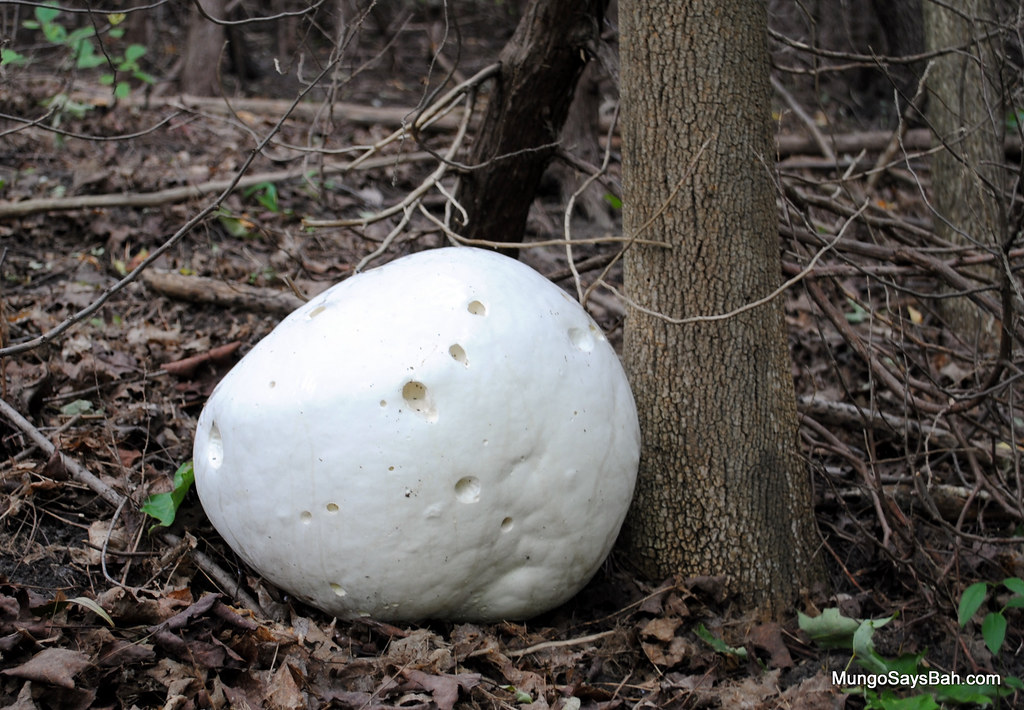
This Giant Puffball shows the characteristically cratered surface, along with an almost bi-lobed body.

I pulled a Giant Puffball out of the ground, and you can see the very small 'root' that provides nutrition to it. This was about as thick as a graphite pencil.

Carrying the Giant Puffball was surprisingly tricky. I didn't want to dent it, and at the same time, the weight of it began to make my arm sore. I mean, it wasn't probably more than 5 pounds, but it was bulky.

I put it on the cutting board, took out the frying pan and stared at the rounded beast before me for a few moments.

I started by removing the base. You can see the base interior beginning to turn brown - the eventual state of this Giant Puffball is a big powdery, dry, dark brown crusty ball, emitting spores into the wind as it crumbles into pieces.

I pared away some of the skin and harvested out the white, firm flesh.

Here is a closeup of the marshmallow-like texture. It was cool to the touch, because of the moisture contained within the tissue.

I skinned the beast.

I cut it up into bread slice thickness.

I noticed quickly that I had way too much to consume by myself, and ended up giving some to my neighbour.

I dredged it in flour, salt and black pepper.

I shook off the dredging powder and laid the pieces aside. I was wondering what it would taste like, but soldiered on.

Soon a rich scent filled the kitchen - and the mushroom began to resemble chicken strips.

It smelled glorious. It didn't smell like normal button mushrooms, more like - well, more like chicken and zucchini.

Into the frying pan, I put a little bit of olive oil, and butter. Once it was hot, I laid the strips of the Giant Puffball onto the pan. It sizzled.

I put it onto a plate, and gobbled it all down. It was amazing. I am going to do this again soon, and highly recommend that every single person reading this post, who lives near Giant Puffball mushrooms, immediately go out, harvest, cook and eat some.

Cheers,

Mungo


Most Popular Posts